The Backyard Bug Hunt
About the Project:
Platform / Medium: Board Game
Duration: Aprox 4 Weeks
Team Size: 2
Role: Rule Book Writer & Board Designer
Platform / Medium: Board Game
Duration: Aprox 4 Weeks
Team Size: 2
Role: Rule Book Writer & Board Designer
This project was a 4-week group project that I did in tandem with a classmate for my Introduction to Game Design course while going to the University of Delaware. For the project, we were assigned a club to base our game on, for us, it was the Entomology Club, and tasked with making a transformative game from scratch.
Initially, we based out game off of the board game Parks, but after a rough first iteration, we decided to ditch the idea and start a new, the game we initially came up with was an open world game loosely based on the board game Parks, rather than the initially strongly based version that we had for iteration one.
Our final version for the project was The Backyard Bug Hunt, a 2-4 player board game where you take the role as a kid in a friend group at the end of summer tasked with collecting more bugs than your friends before the end of the day. We intended to try to inform and transform players perception of bugs by portraying bugs in a fun and peaceful light whilest also providing fun facts about the various different bugs we could encoutner in our dialy lives.
.pdf.jpg)
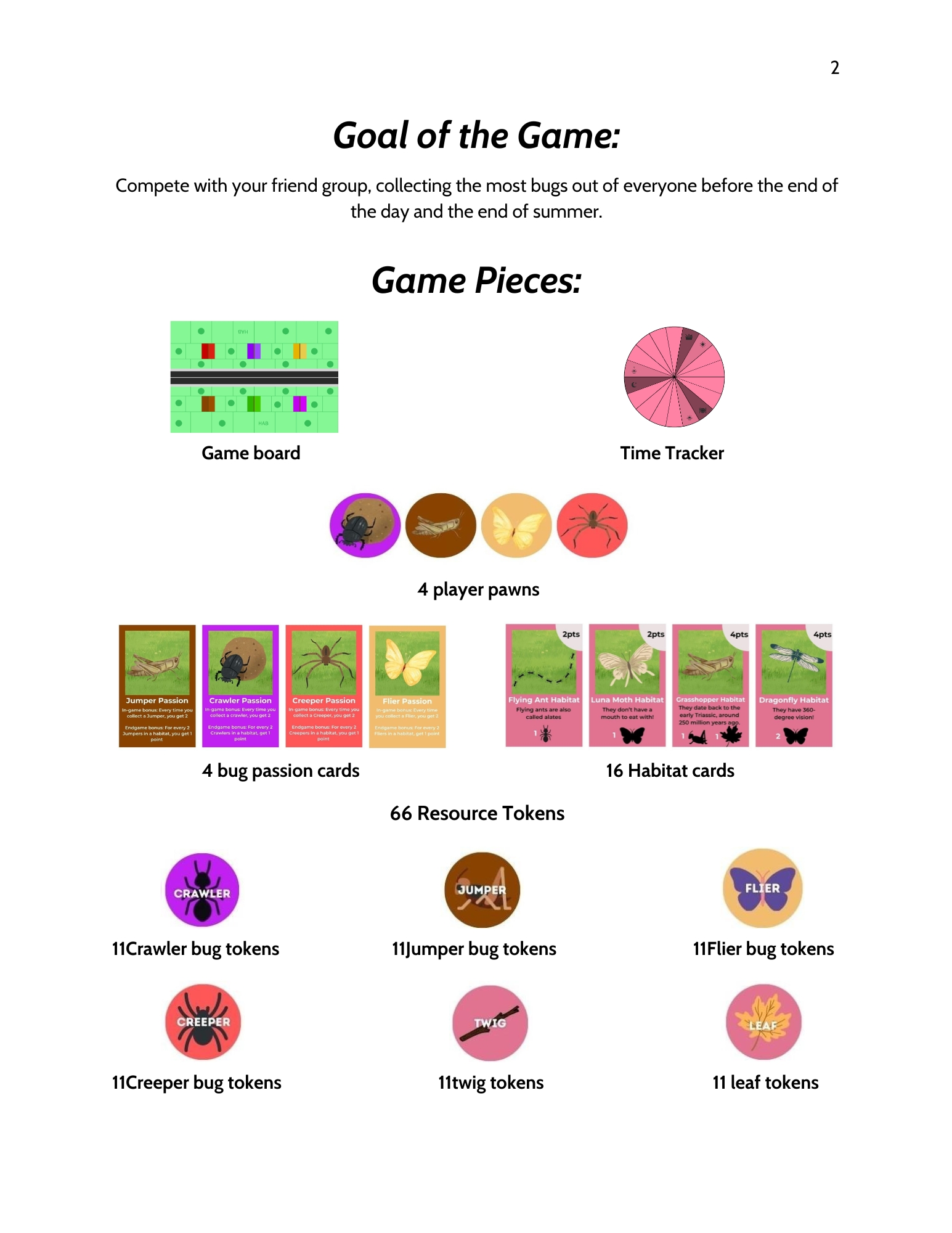
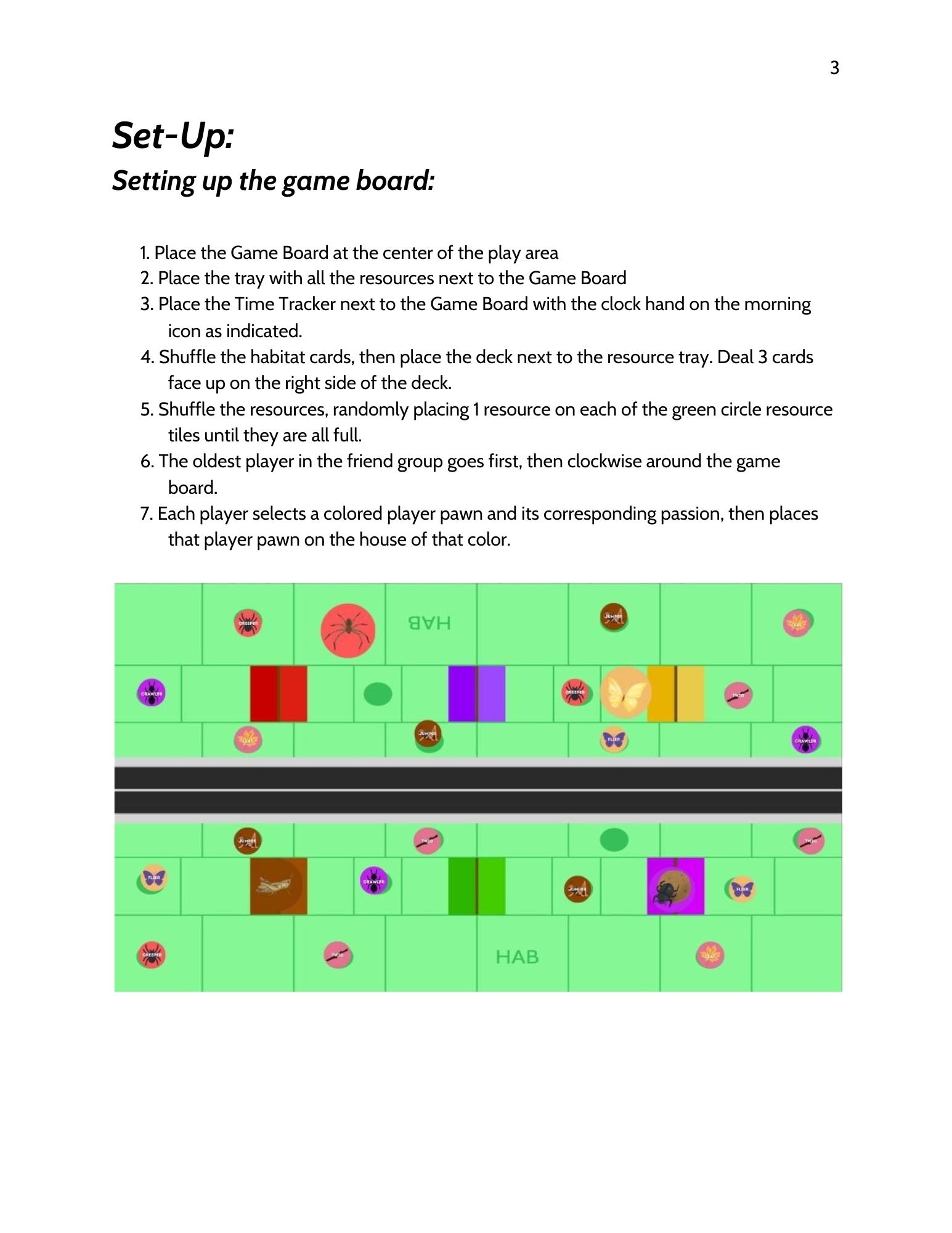

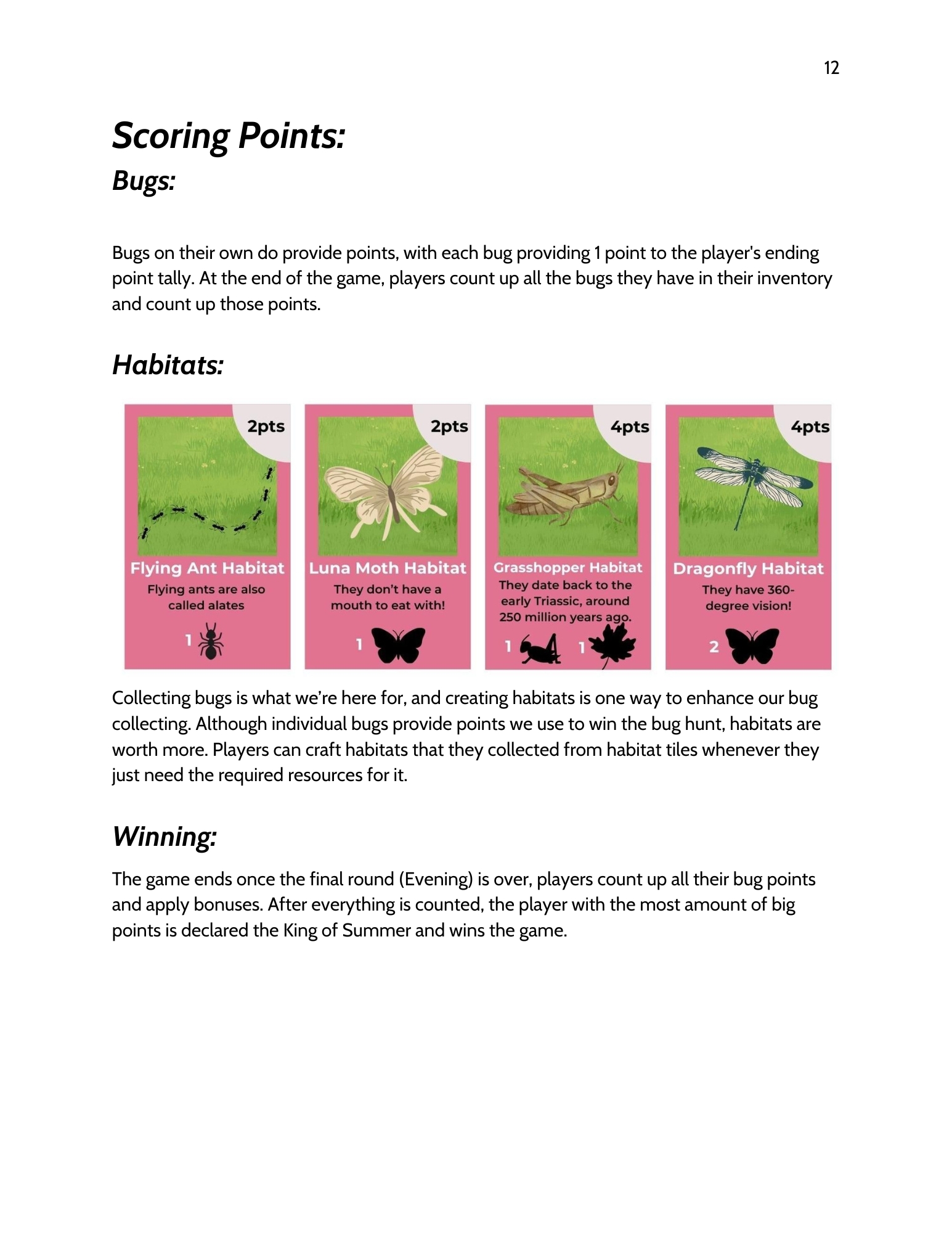

My main contribution to this project was in developing our rule book in terms of writing and formatting, and creating the game board and time tracker. In general sense though, because since it was a small team, we both did a little bit of everything.
For our first iteration, me and my classmate both took a rough idea of what the board game parks was and wanted to test a simplistic version of it and figure out what the reception of it was and where we could go from there. We intitially also had ideas of a game more inspired by the 1989 Disney film Honey, I Strunk the Kids and the Obsidian game Grounded, where we would have a cast of kids who were shrunk down to bug size and we're tasked with getting parts to rebuild the shrink machine to get back to normal size. That idea we had issue with and then fell in love with Parks so we decided on a prototype heavily inspired by Parks.
When going with the parks inspired game, we ran into major road blocks, and couldn't figure out our own spin on how to properly modify the game with how the movement worked. After a few rounds of play testing, and peer feedback, we decided it was time to fully scrape the concept of this Parks inspired game. Although we did scrap alot of the element of this initial iteration, much of it stayed with us until the end.
-images-0.jpg)
-images-2.jpg)
-images-0.jpg)
-images-1.jpg)
For iteration 2, we ended up retaining some of the concepts and ideas we made up in iteration 1 and redoing most of the game board and movement system. One of out initial ideas, before iteration 1, we thought about a more open world game board that we ended up fully implementing in this version of the game. We retained much of what we had in the first iteration of the game, having resources, passions, crafting habitats, and trying to get more points than the other players.
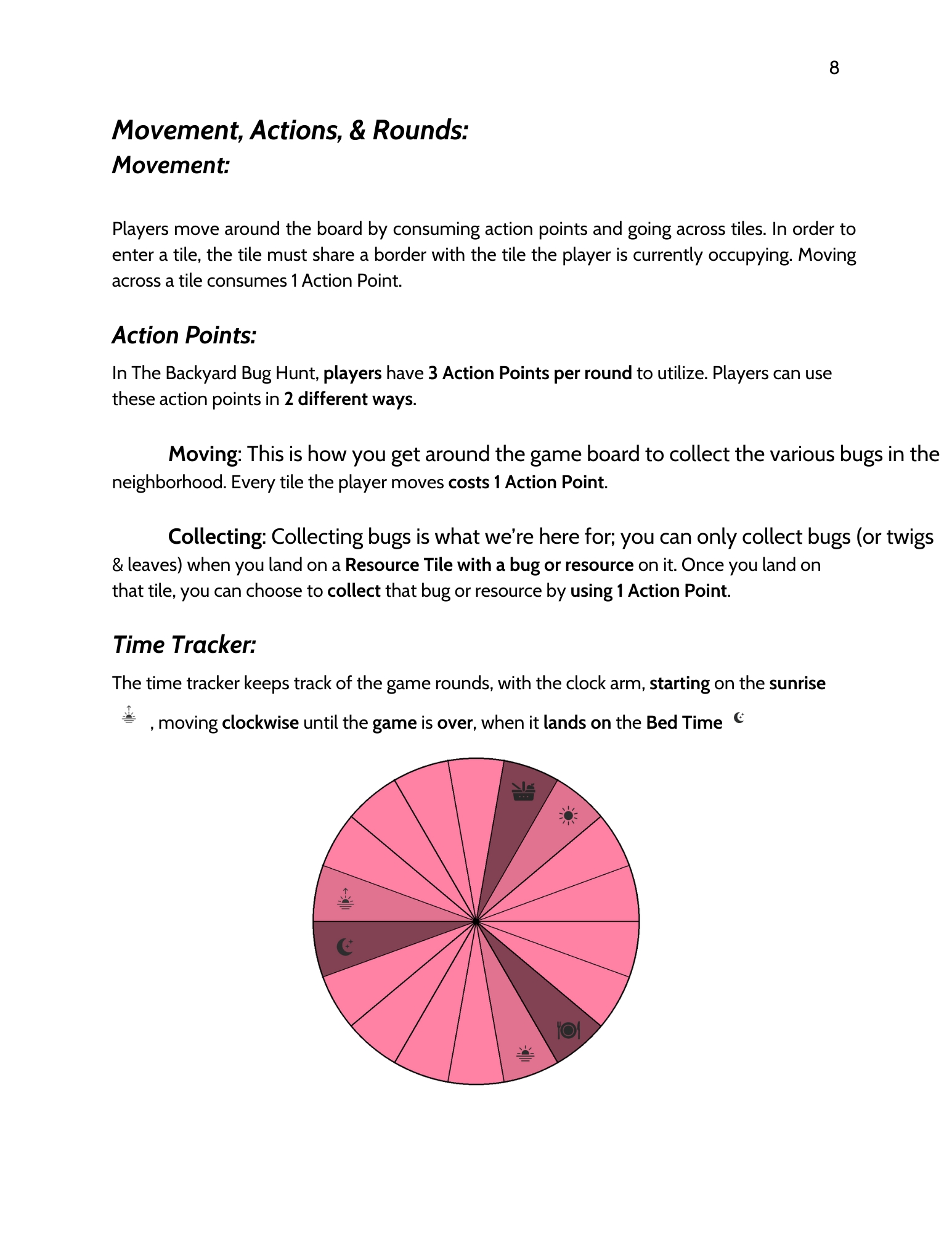
We ended up taking out experience from playing video games and RPG games and implemented a round limit via the Time Tracker and having an action point system in which players would use action points to move around the map
Through our play testing, players we're much more receptive to this version of the game and gave us direction on how to proceed in the future. From this point on, we had the game we wanted to build, and iteration 3 would come down to refining what we had, adding artwork to the game, and balancing.
-images-2.jpg)
-images-3.jpg)
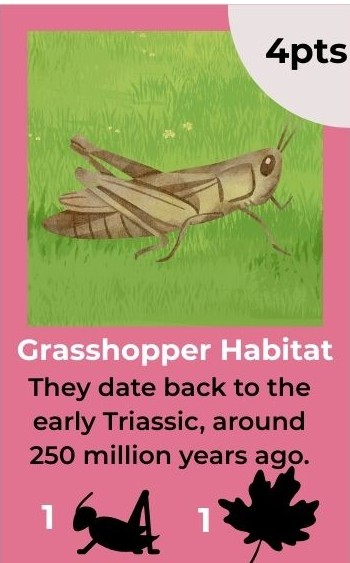
As previously stated, iteration 3 was more focused on refining what we had and polishing the game. And that is what we did, completely revamping out game board, passions, habitat cards, and tokens.
This version of the game I am by far the happiest with, and it is finally in a state that is playable from start to finish. Predictably, there is still a little bit of jank, but that will be addressed later on.
These illustrations demonstrate what we had at the end of iteration 3.
.png)
-images-0.jpg)
-images-1.jpg)
-images-2.jpg)
The biggest problem and most stressful problem through the whole designing process was the issue we ran into with our first iteration of Parks and figuring out what to do after that clearly was not going to work out. It was hard, but as a team and a designer, we had to face the data from play tests and peer review that players we're just not happy with what we created and were faced with the hard decision to scrap what we made.
How we dealt with this was going through, and making a list and discussing what in the game worked and what wasn't working so that we had a base on where to go. We decided we liked the idea of collecting bugs and the crafting of habitats that we derived from the crafting/ visiting Parks system in Parks. We realized, the heart of the issue of the game in that first iteration was the game board.
We ended up fixing this issue by mocking up a few game board concepts, until something stuck, the one that initially stuck that we wenr't with was the open world game that went well with the idea of collecting and getting more stuff than the other players.
Another issue we had way early on in development was where to go, with the game. The nature of such a broad topic of bugs with no sense of direction on a type of board game to make was a problem for us in that it caused us issue on where to go with our initial iteration.
We had so many different ideas for a game to make that it was absurd, and we truly didn't know where to go with it or where to base the board, theme, story, or central mechanics.
Lucky for us, we played the game Parks in class, which we decided would be a fun concept to base the game off of. This would come up and create more issues for us though.
Because of the time constraints, it was very difficult to get the first two iterations done in time, especially with us having so many different ideas for how we wanted to go about the game and it helped us work under pressure. It would have been nice to try out all of the five initial very different concepts that we came up with to decide on which one was "the best," but the truth is, with the time we had that just wasn't possible. Instead, the five initial concepts we had, we had to determine what concept was the best and what elements of the other four we could implement into that chosen concept.
It was very hard to do that, but because of the time constraints it forced us to choose something and go with it.
One of the initial things we wanted to impliment into the game never fully commited to it in any of our drafts feeling that it was going to be difficult was some sort of item system, one similar to that in Parks, that would help players collect bugs and give them a bonus. Because most of the development phase was figuring out more mechanics and on how we wanted those to work, we never implimented it, but if I came bad to this project I would love to add to this.
Although, it's current form, habitats are workable and serviceable, I still do not feel they are optimal and require much more balancing to them. If revisited, I would want to do extensive testing with this system to figure out optimal recipes and spacing of resources on the game board to make it more competative.
Again, just like habitats, the game board is another thing that I felt was servicable and workable yet not satisfying. The board suffers from a similar issue with habitats in that balancing is off and choices feel like they lack meaning and consequence , and if returned to, I would want to add on to extensively playtest and iterate it.