← Back to Highlights
VIDEO GAME

Burden (WIP)

A 2D platformer for younger middle schoolers, designed to make the player feel empathy for a talking rock they carry with them throughout the game.
Engine
Godot
Duration
14 Weeks/1 Semester
Team:
10 People
My Role:
Writing

Game Overview

A 2D Platformer targeting a younger Middle School demographic designed to make the player feel empathy to a speaking rock that they carry with them throughout the game. It is a semester long interdiscipinary project for GAME467: Game Design Studio where a team of 10 get together and follow a pronged requirment. The theme of the project is Empathy and the technical requirement is that there is a NPC that appears at least three times through the game changes physically each time.

My Contribution

  • Start here...
  • Start here...
  • Start here...

Project Evolution

PRE-PRODUCTION - WEEK 1-4

Team Assignment & Pitching Process

We didn’t get our theme or team assignments until the end of week 2, so we quickly set up a Discord and sorted out initial roles. To help get the team on track during that hectic first week, I took on more of a production role.

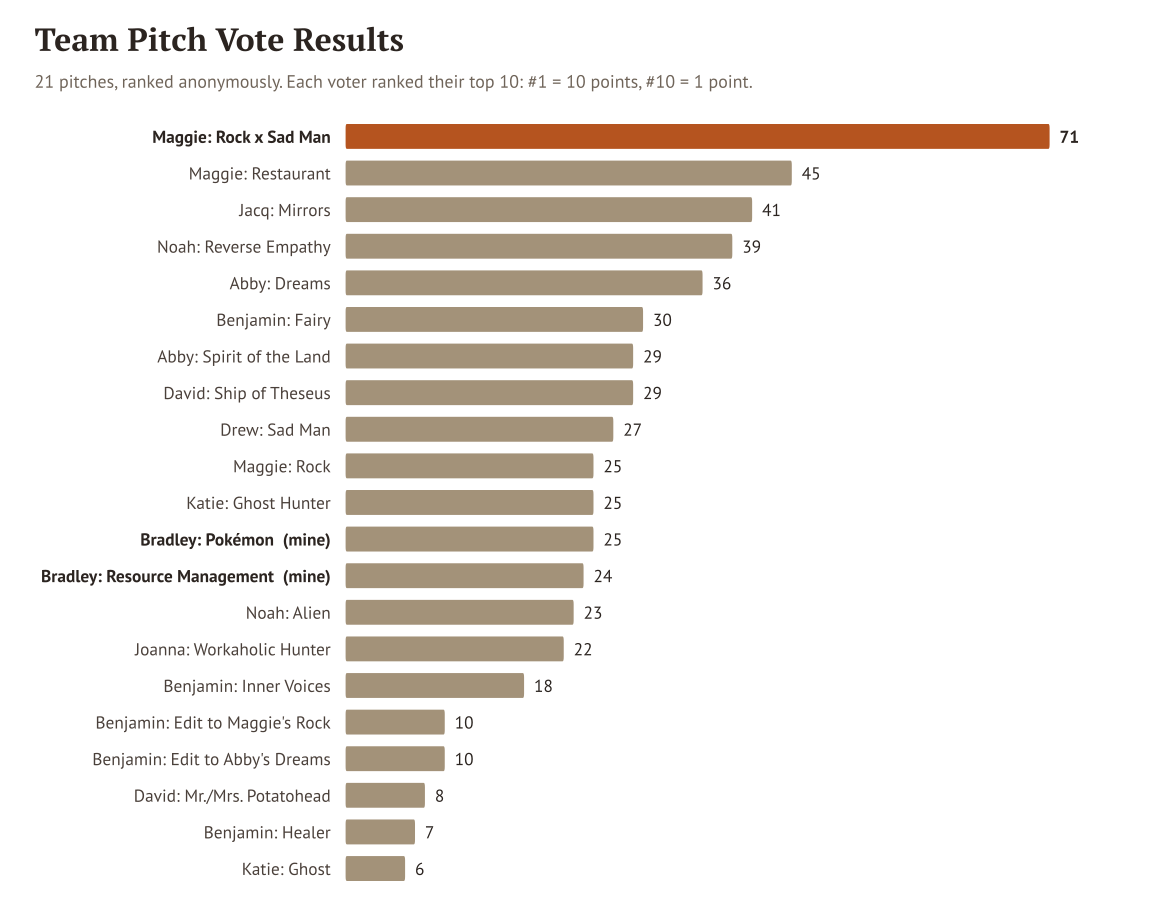
One of my first suggestions was to open up pitches to anyone on the team who had an idea. After about a week and a half, we held an anonymous Google Form vote where everyone ranked their top 10, with #1 worth 10 points and #10 worth 1. That way everyone’s voice was heard, and we’d end up on a project the whole team actually wanted to make.

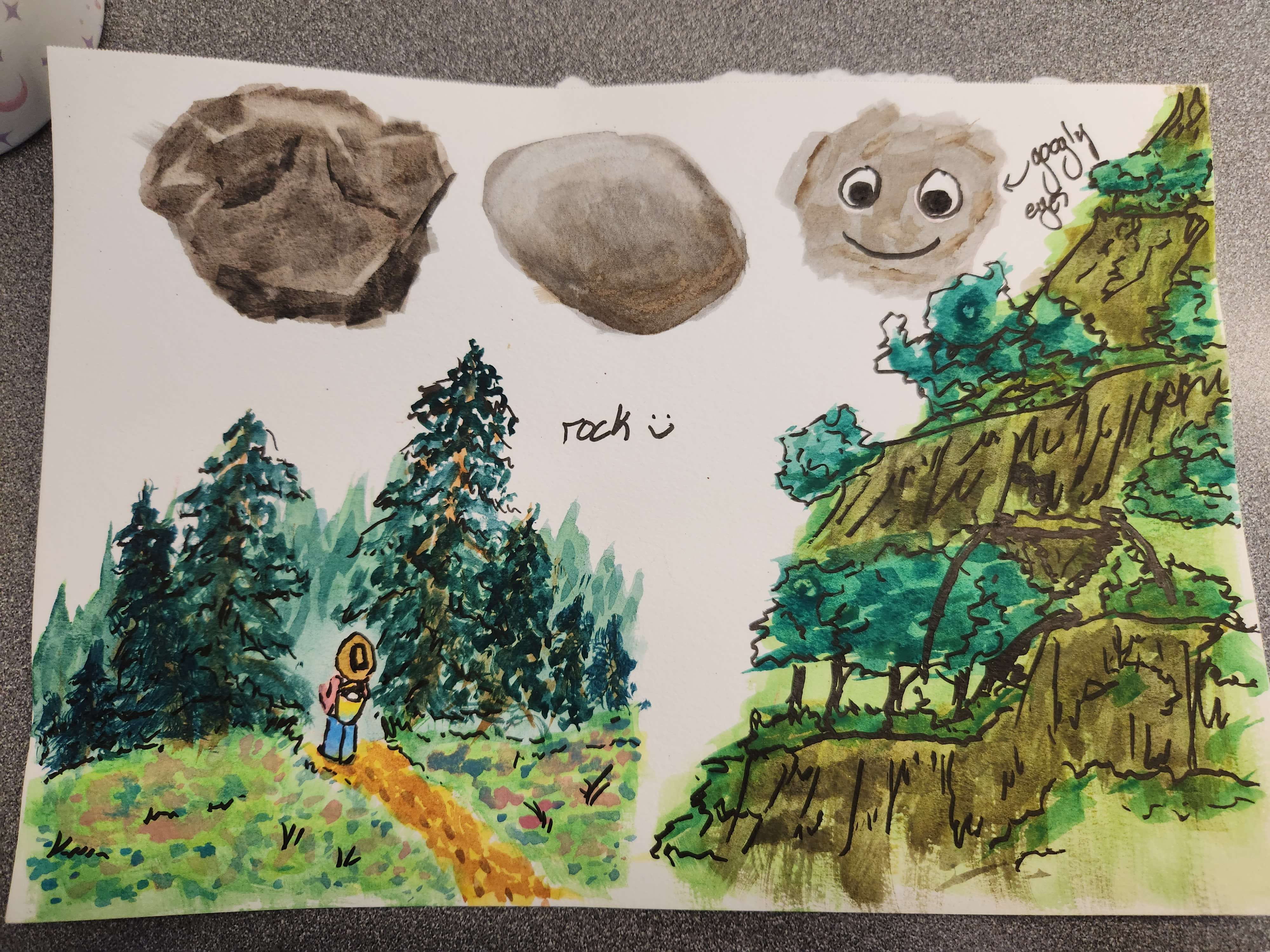
The clear winner was Maggie’s pitch, which combined two of the team’s favorite ideas: Drew’s Sad Man, about a depressed NPC who’s a burden on the player but essential to finishing the game, and Maggie’s own Rock, about a talking rock found on a mountain climb. Her combined pitch:

“The Sad Man IS the Rock.” An adventurer climbing a fantastical mountain finds a talking rock and can choose to bring it along or leave it. As it opens up, the player learns its brother died at the top of the mountain they’d dreamed of climbing together, and eventually the rock reveals it was a person all along, a metaphor for being stuck in apathy after a loss.

Design pillar: a puzzle platformer where you have to reach the top.

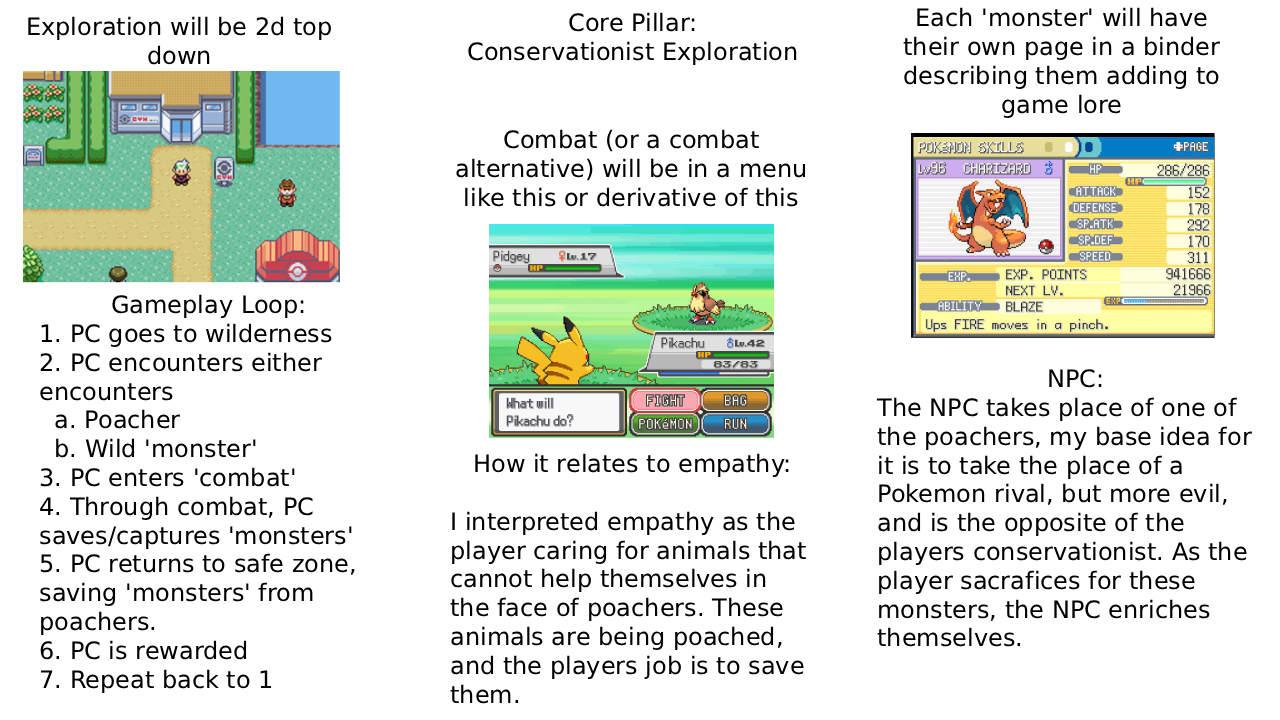
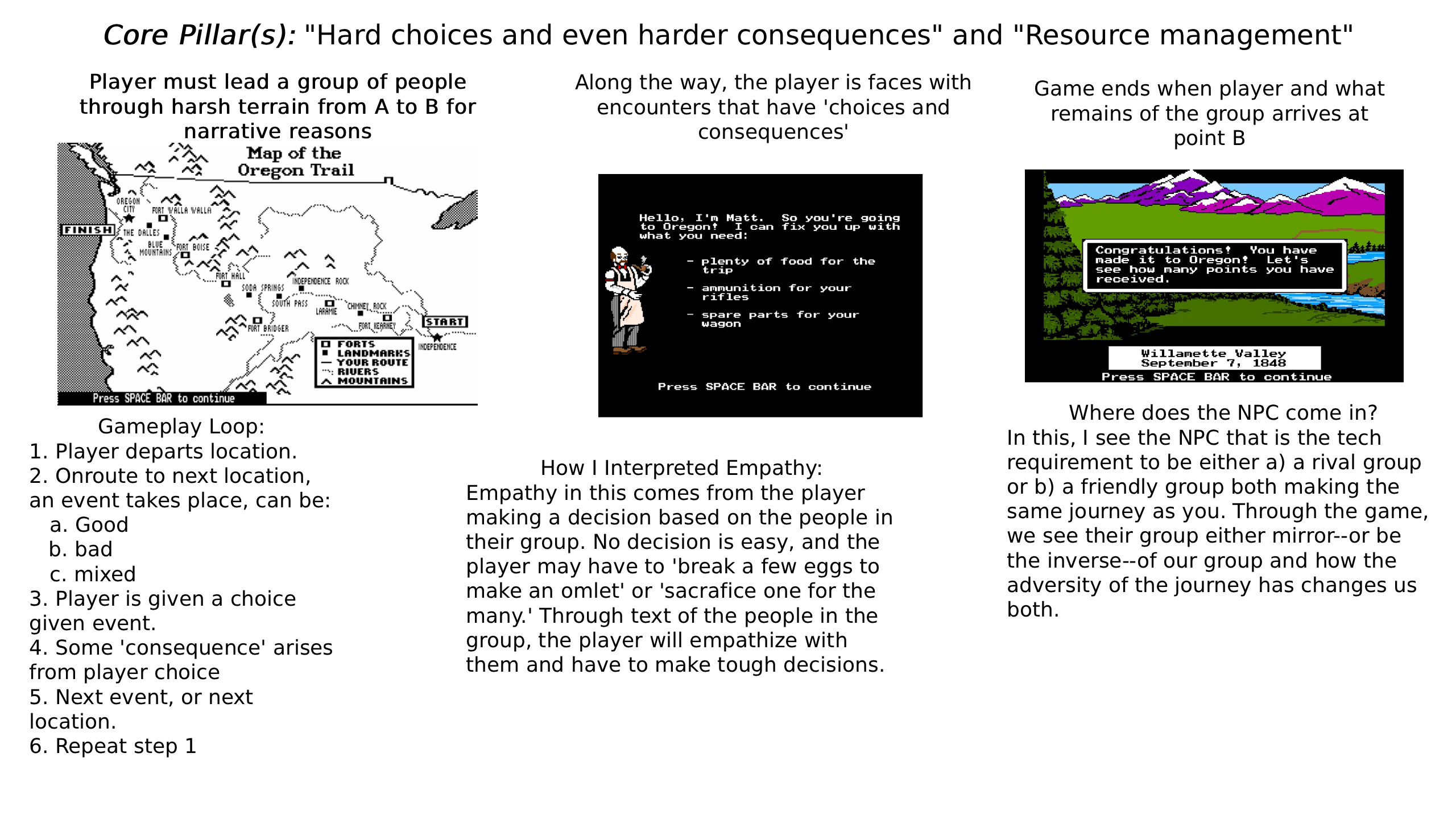
My two pitches, shown on the right, landed in the middle of the pack. Looking back, both were pretty derivative, one of Pokémon and one of The Oregon Trail.

From here, I shifted to the writing team as 1 of 3 writers, with Maggie and Jacq. We also named a producer for each discipline, Ben for programming, Katie for art, and Noah for writing, so decisions could actually get made instead of going back and forth. With that in place, we started asking the big questions: Who is our main character? Who is our rock? Why are they a rock? What kind of world is this?
WEEKS 4-7

Finding Our Footing

The first few weeks of development were slow, with a lot of housekeeping, meetings, and core decisions to make. For the writing team, that meant brainstorming and debating, in class and on Discord, about where the game should go. Who was the rock? Was the world fantastical or contemporary? We also brought in the rest of the team, so non-writers had a voice in the narrative too.

Early on, I pitched a more traditional fairy tale, with a selfish-to-selfless arc and more mature themes. The team leaned toward a simpler, child-friendly story instead. I thought the prompt lent itself to a heavier narrative, but I committed to the team’s direction, and those discussions got us to a shared vision.

To cut through all the ideas, we settled on design pillars: Empathy with an inanimate object as our core, with Simplicity and a Storybook aesthetic as secondary pillars. Simplicity shaped the writing most. Anything not essential to the story stays vague, so the rock’s backstory is only implied: he was once in the player’s shoes, refused to help someone in need, and became the one in need himself. In a September 27th writing meeting, we also raised the idea of the spirit at the end of the game doubling as a narrator and tutorial guide.

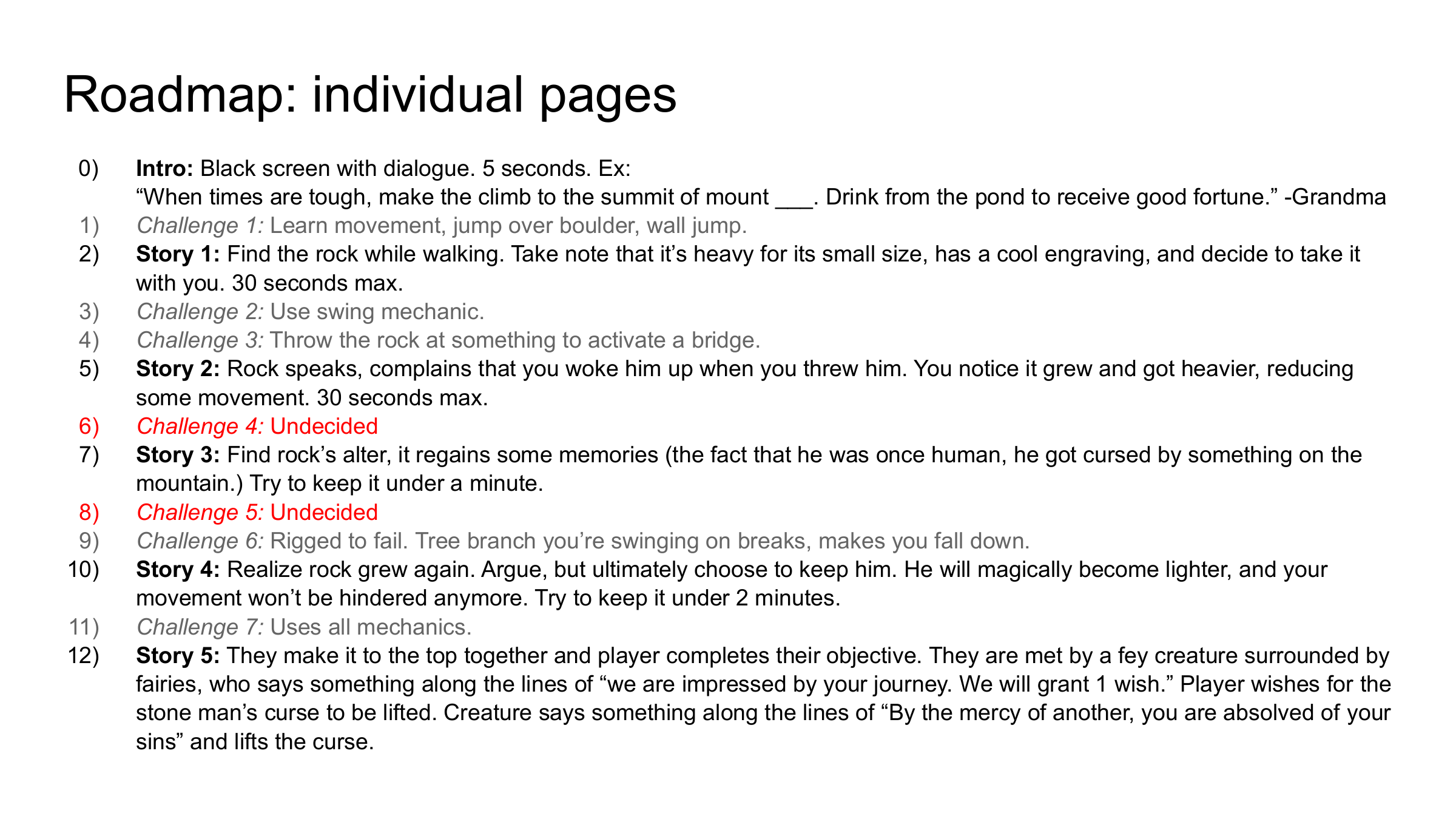
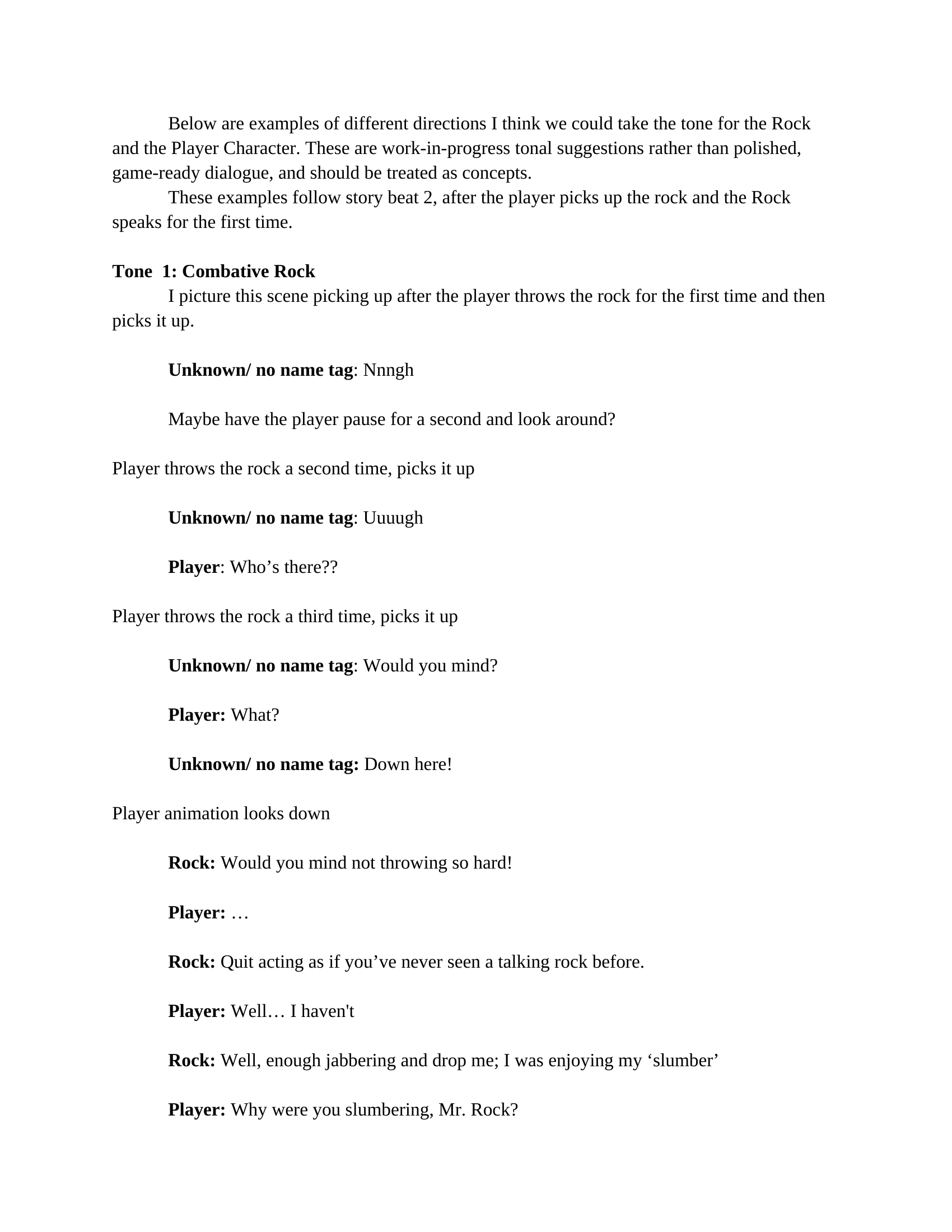
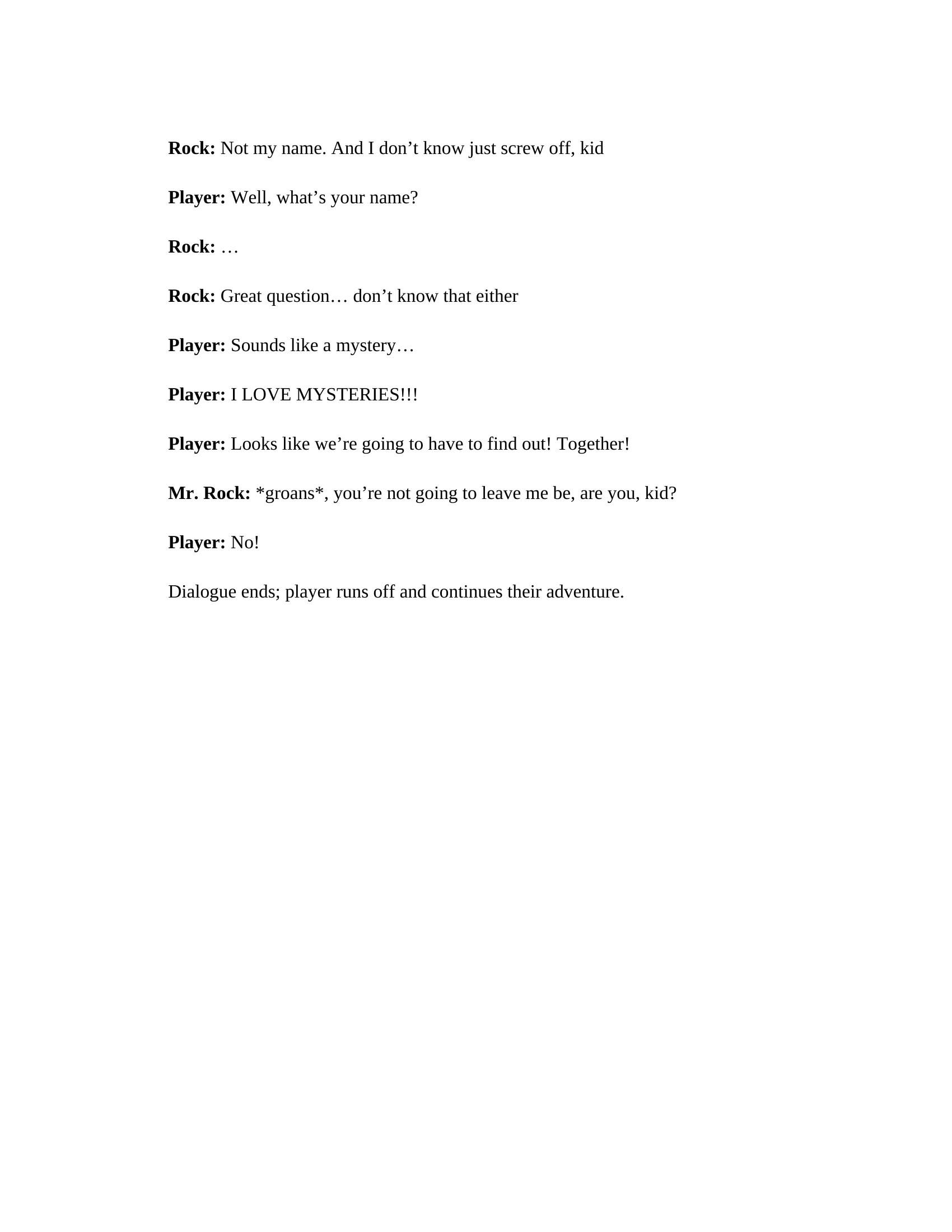
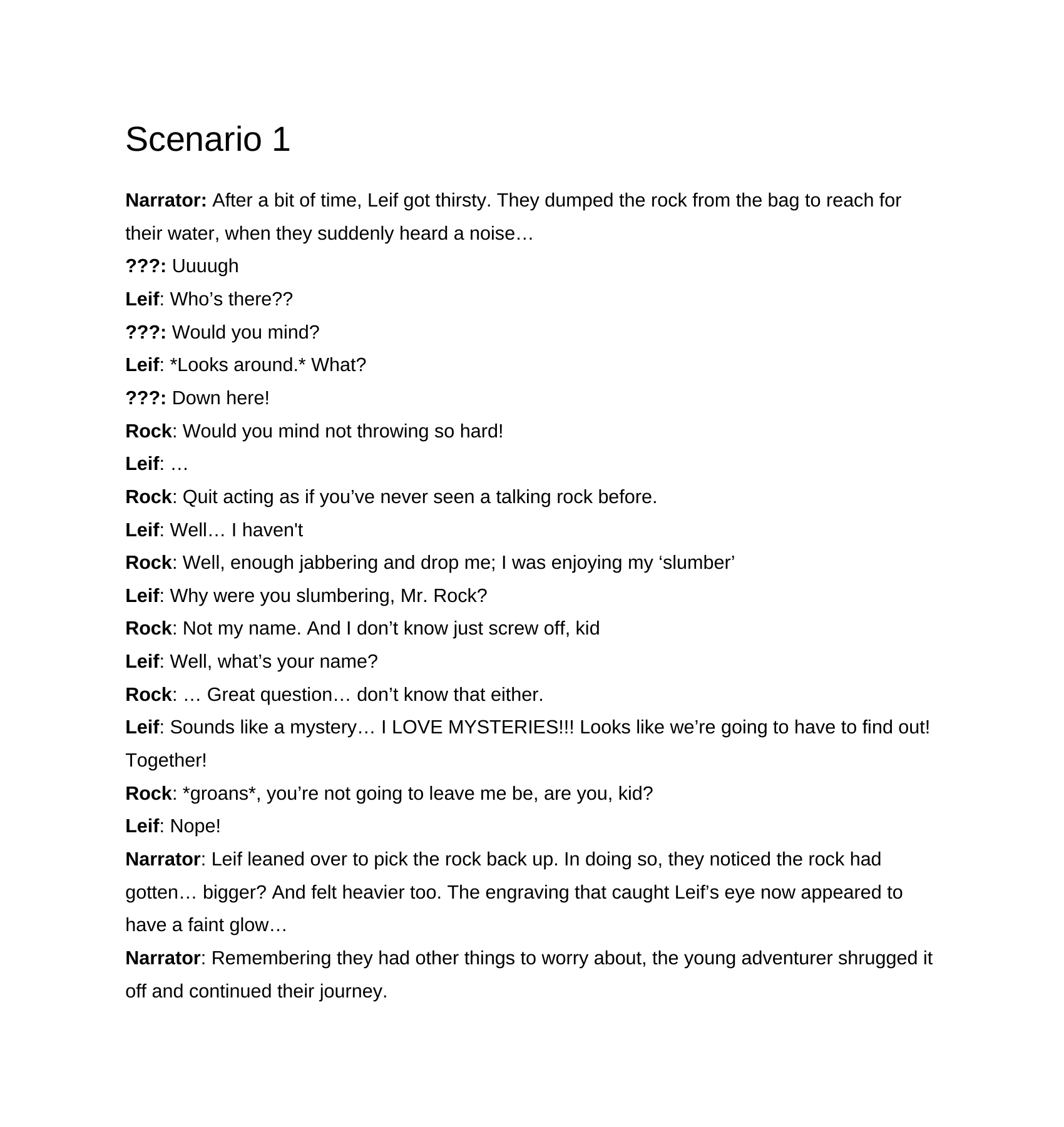
Our producer Noah then put together a roadmap of the bare-minimum story beats (shown on the right) to keep us on track for playtest 1. Next, we tested the tone of the rock and player at their first conversation. Each writer workshopped tones independently. I wrote three, putting the rock on a spectrum from combative to disoriented to friendly, with the player mostly reacting so testers could focus on the rock. Our producer picked one piece from each writer to cover that spectrum for testers, and my combative version was the one chosen from mine.

PLAYTEST #1 - WEEK 7

Finding Our Tone

Although I was home sick for playtest 1, it turned out to be a big one. About 15 playtesters came to test both teams’ games, the best turnout our professor said he’d had since he started teaching the course.

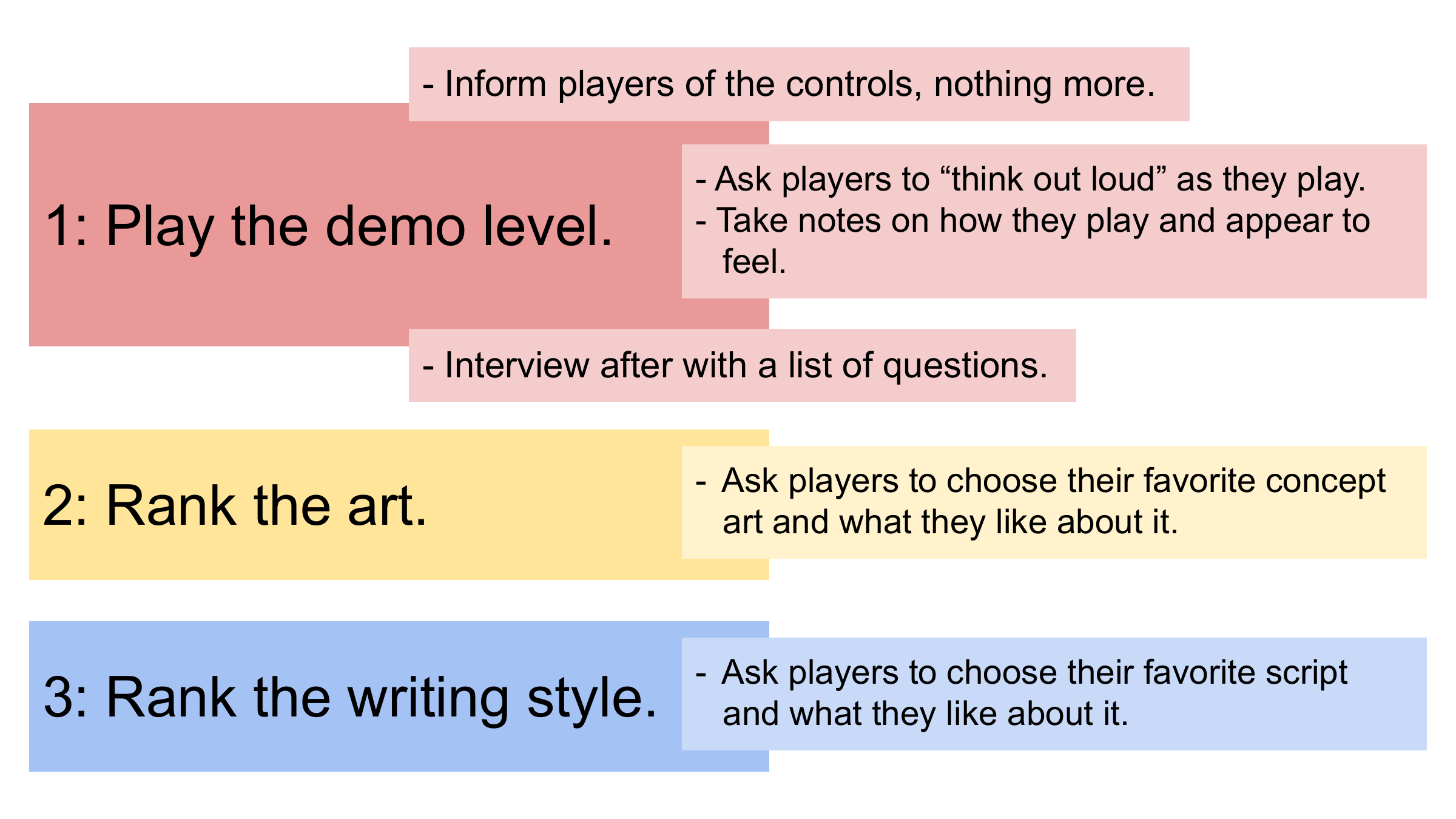
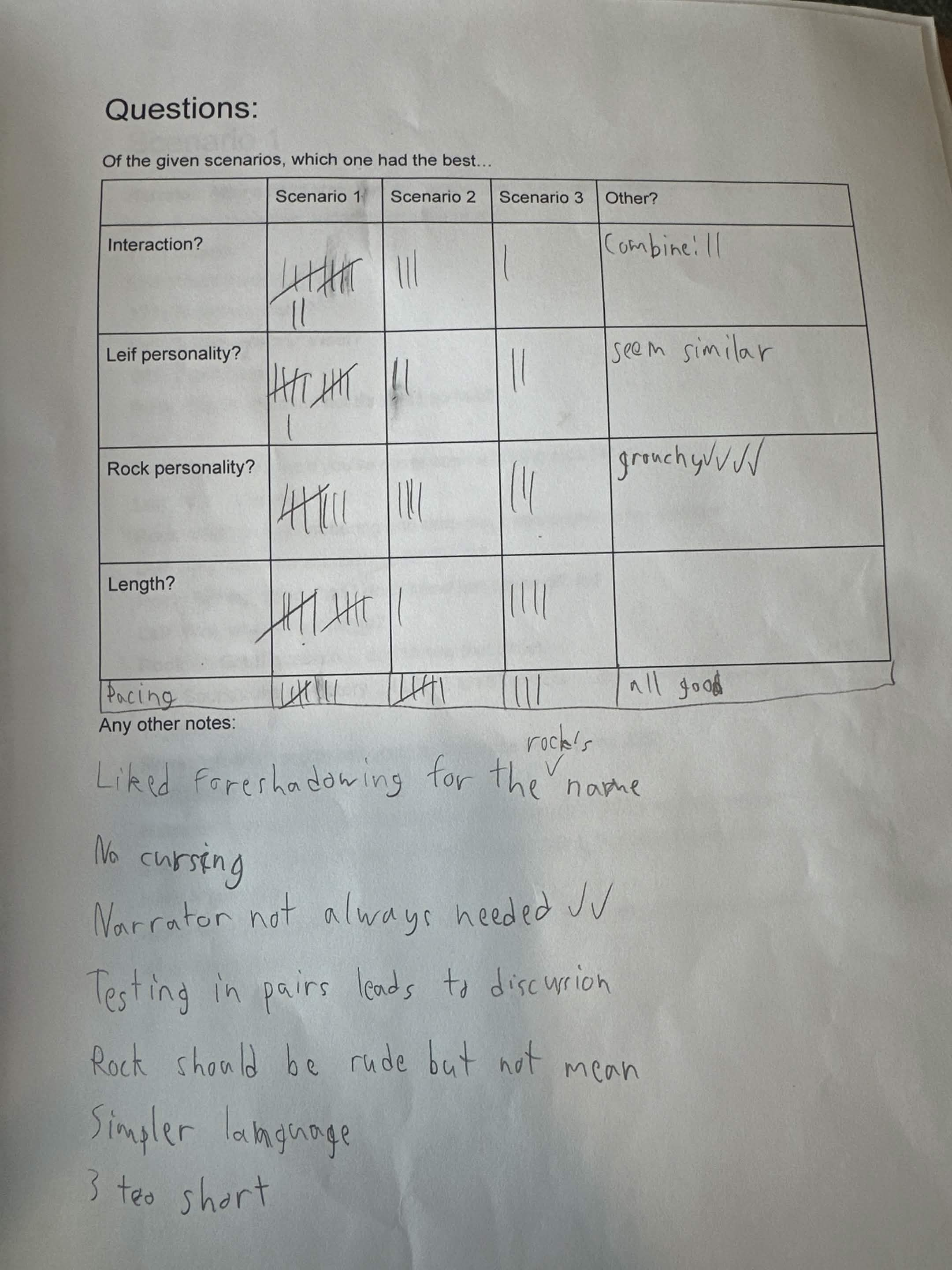
We structured the playtest so each part built on the last. Players started with gameplay, then picked the concept art they felt matched it, then chose the writing tone that best fit both. I was a strong advocate for this format, so players were judging the writing as part of the whole experience instead of in a vacuum, and we felt it was a big part of why the reception was so strong.

My combative rock (Scenario 1) was a clean sweep, winning every category testers voted on. They loved his grouchiness and compared him to Oscar the Grouch, but felt he should be rude, not mean, so we’re keeping his attitude while cutting anything that crosses the line, along with simplifying the language for our younger audience. Players also liked the foreshadowing in the rock not knowing his own name, though many assumed that meant they’d get to name him. They felt the narrator wasn’t needed, so we’re reworking it into a tutorial-only role like the bird in Celeste, and they questioned why the main character was climbing at all, so their motivation needs to be clearer. As a team, we also named our protagonist Leif.

With only two weeks until playtest 2, during midterms, we kept our scope small. The writing team is refining the tone from my sample, possibly adding barks, and having the rock slowly become less grouchy over the game, similar to Joel warming up to Ellie in The Last of Us.