Presto - The Board Game
About the Project:
Platform / Medium: Board Game/ Card Game
Duration: Aprox 3 weeks
Team Size: 2
Role: Writer and Game Designer

Platform / Medium: Board Game/ Card Game
Duration: Aprox 3 weeks
Team Size: 2
Role: Writer and Game Designer
Presto - The Board Game was I project that I worked on in the Fall of 2025 while studying at the University of Delaware. I made this game while in a Introduction to Game Design course in my Junior year of college and did so in team with another classmate. At the start of the project, for the project, we we're randomly assigned to short animated films and tasked with making a game about it set in that world. Besides that prompt, as designers we we're only given the film to work with and no other constraints for the project.
Based on the short film we we're assigned--Presto (2008) by Pixar-- we determined that
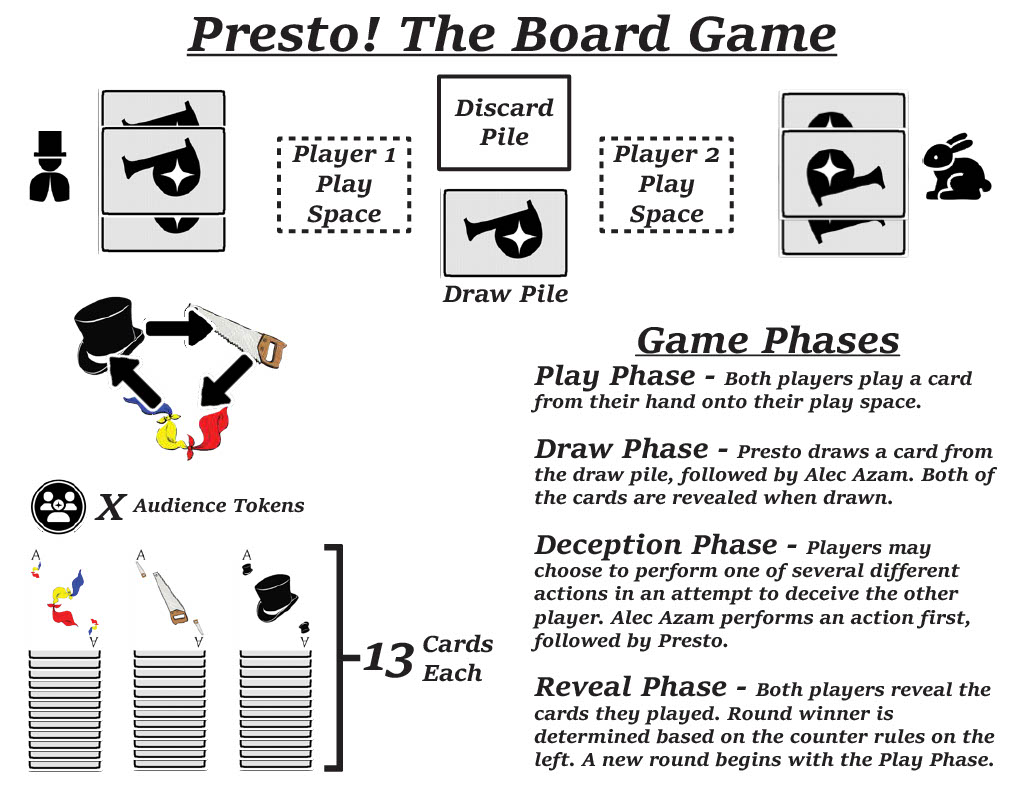
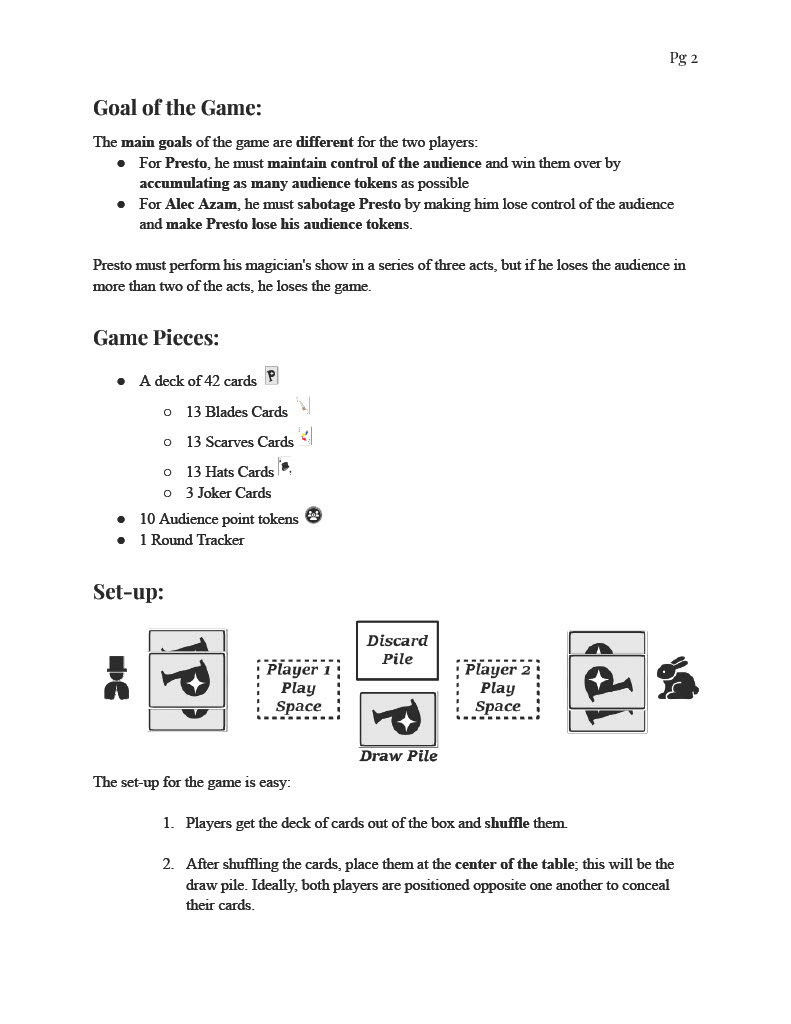
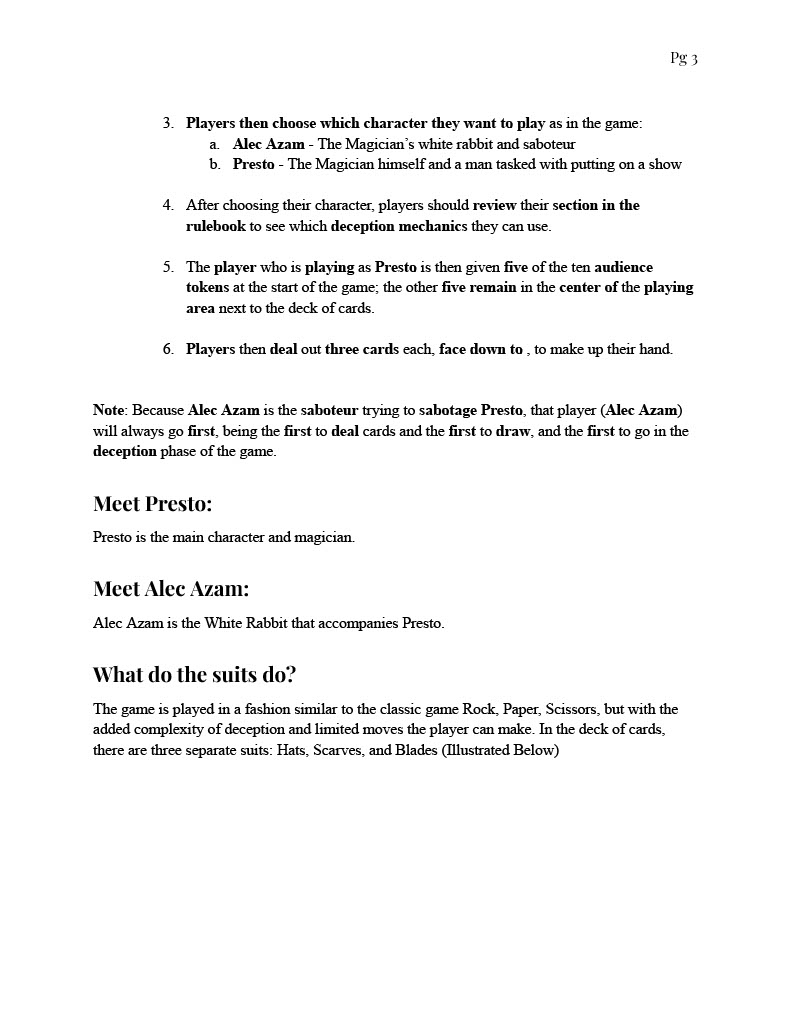
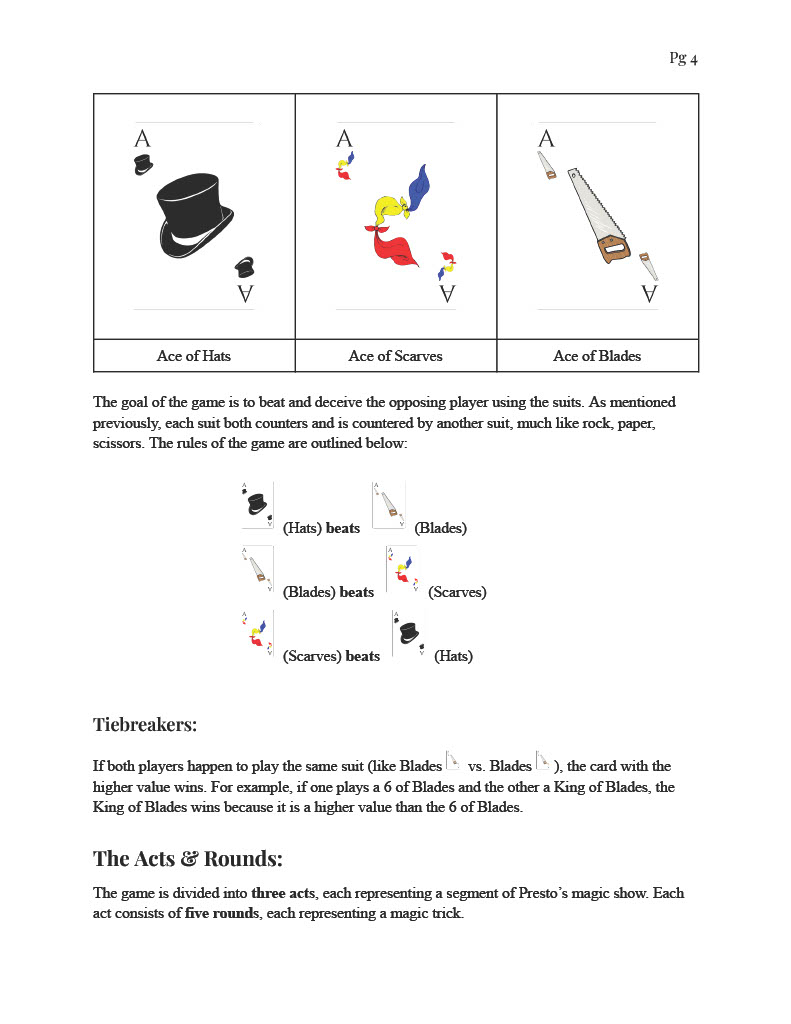
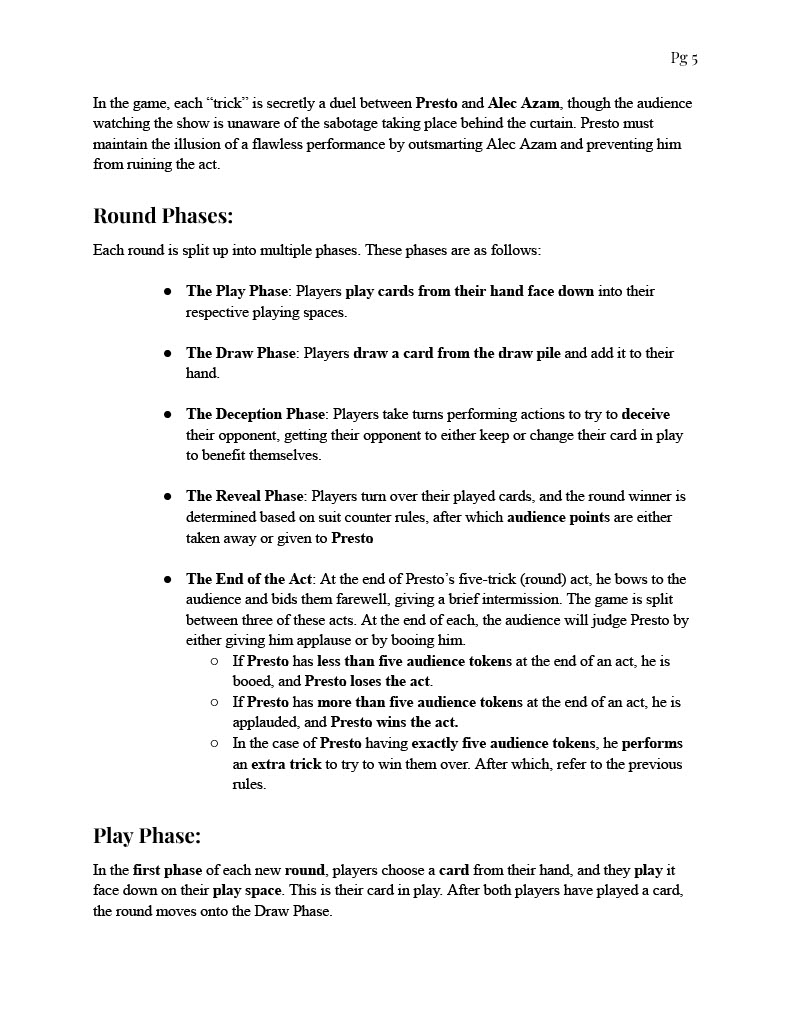


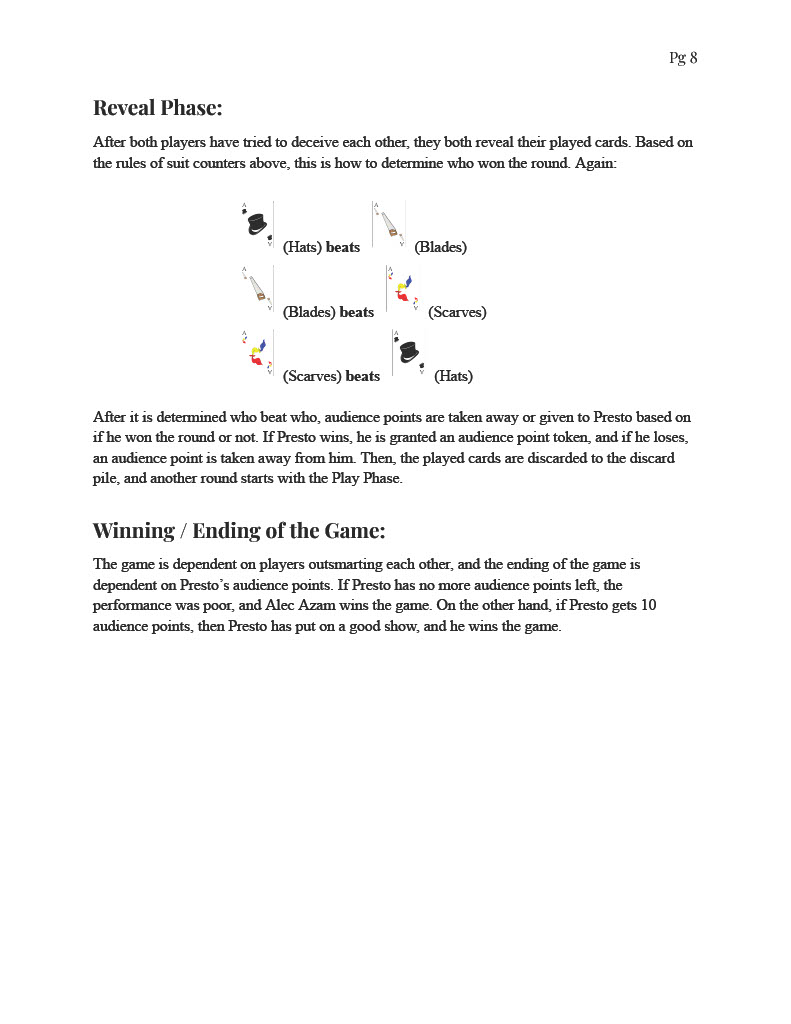
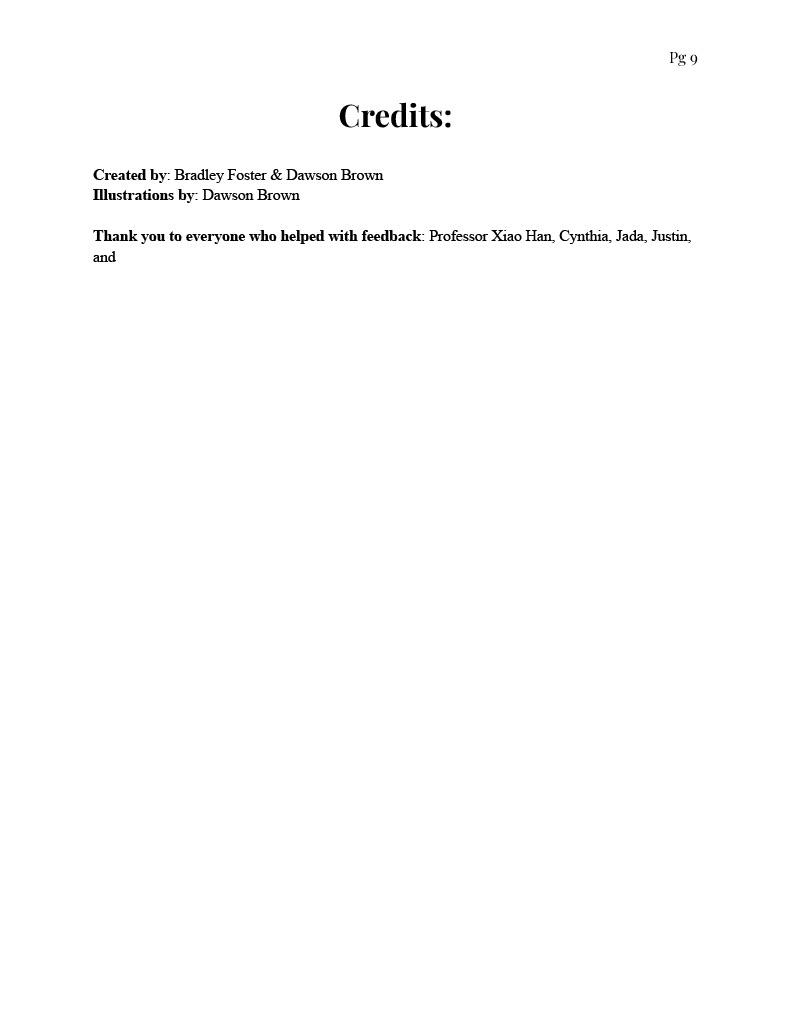
For the majority of the project I was focused on two distinct aspects. That was working on the games rule book. This includes everything about it, phrasing, structure, wording, etc... where my group member would help finalize it. The other aspect that I worked on the most was specifically the deception mechanic for the game and the abilities/ moves that encompassed it.
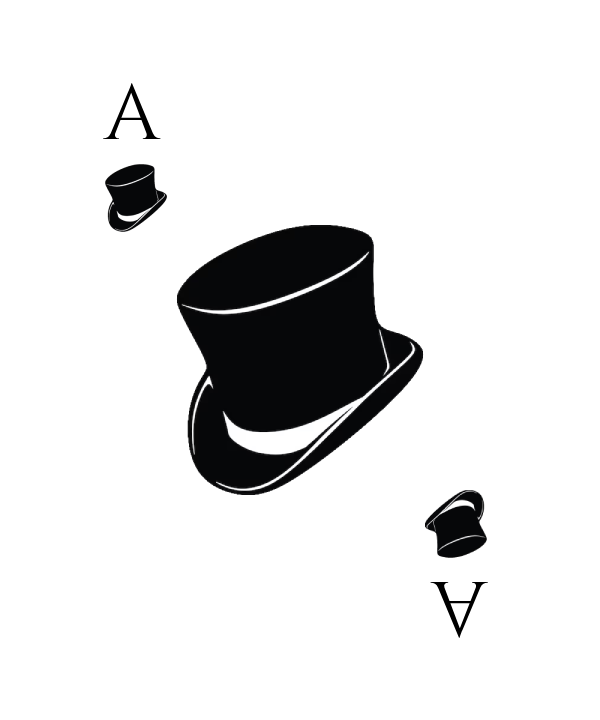
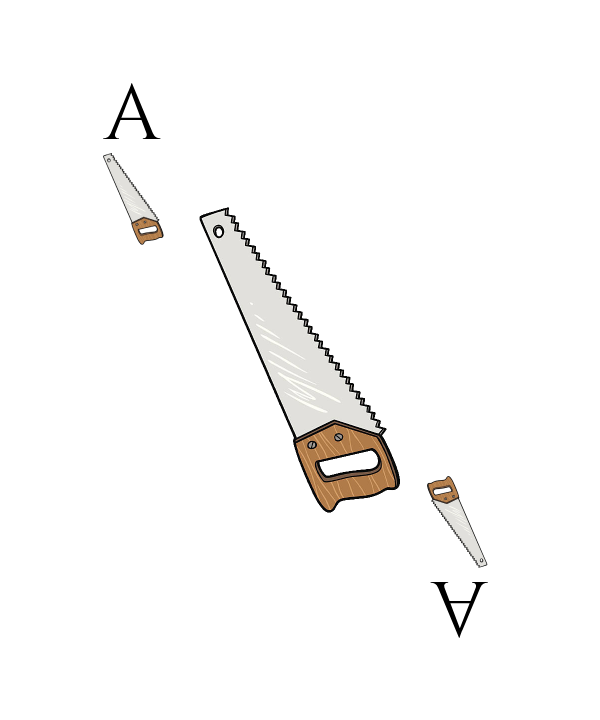
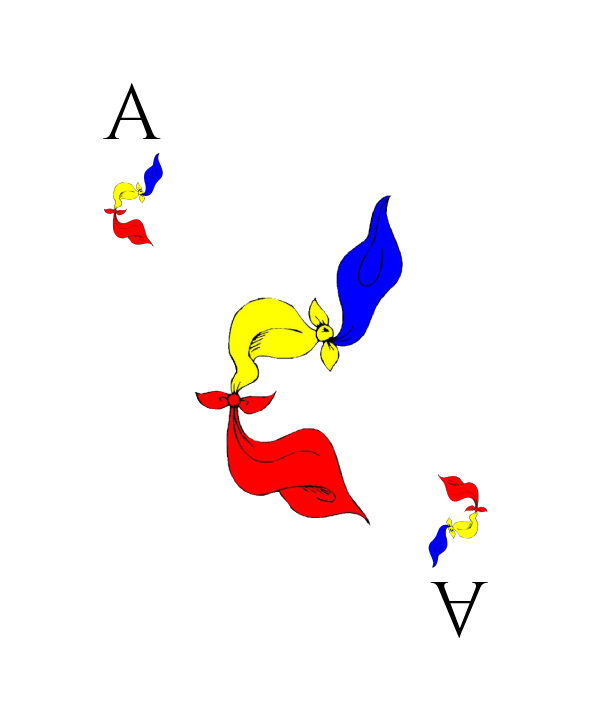
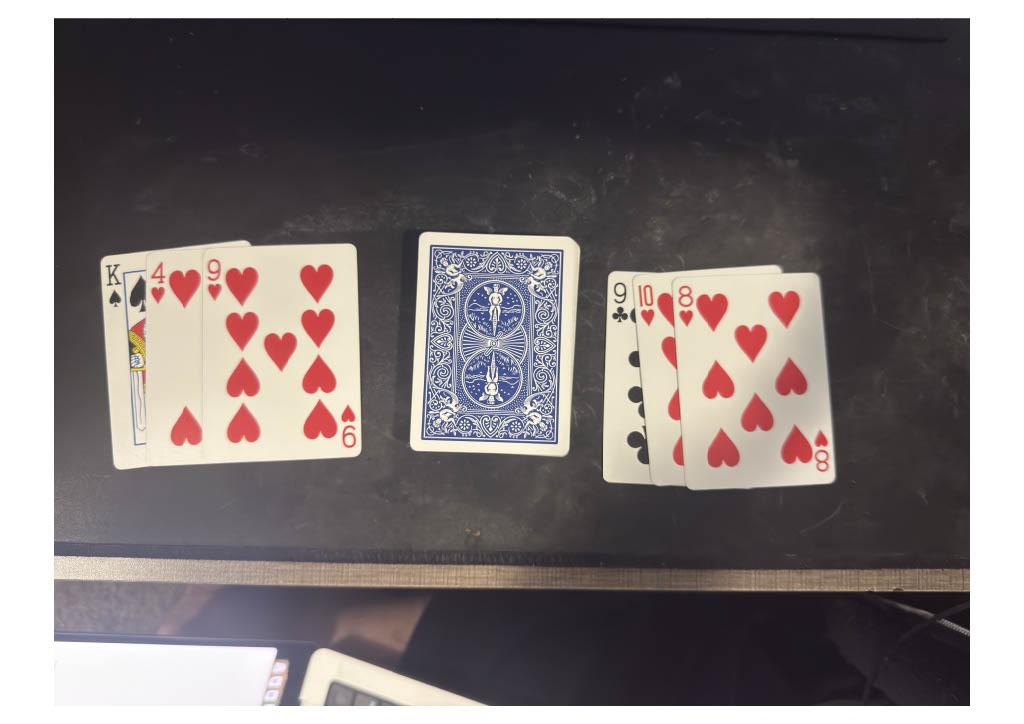
For the first iteration of the project it was mostly just brainstorming on how to establish the foundation. The actual bones of the game were made here but Presto - The Board Game was fully implemented and realized in our second and third iterations of the project. For this first iteration, we were really brainstorming the viability of a Rock, Paper, Scissors combat game between two-players. With this we played around a lot with the deck, deciding and thinking about how many cards we would need and playing the game against each other to see if it really worked out.
During this iteration of the game we realized a few things we needed to tackle if we wanted the game to go forward as is: What the hand size needed to be? How many cards? What information do players have? What kind of third element can we add to the game to make it more exciting?
That last question was of primary importance for our second iteration, and as a team we got togetehr to brainstorm what that third element of the game would be, which took place and was implemented in our second iteration.
.jpg)
For our second iteration of the, we really wanted to hone in on this card game idea, but as previously stated if we moved forward with it we would have to have some extra element. As a team, we brainstormed numerous different ideas before we came up with our deception mechanic that became the focus of the game.
Initially, we thought giving abilities to the cards would be interesting, and I discussed bringing in a mana pool and taking inspiration from TCG (Trading Card Games) like Pokemon and Magic The Gathering. Although I liked the idea, my teammate shot it down, likely rightfully so because it would be too overly complex and given team size and time constraints would not work out. Other mechanics we thought of before settling on the deception mechanic was some more simplistic form of card abilities and an implementation of a game board while also using playing cards.
ultimately, as a team we came to the conclusion that form of bluffing and deception would go well with the theme of Alec Azam sabotaging Presto and would go well with not fundamentally changing the Rock, Paper, Scissors aspect of the game.
We also encountered issues with the game not having a round limit at the end, and despite us having audience tokens as a win condition, the round seemed to go on indefinitely in our play tests.
So for Iteration #3, our concerns as a team was getting the game to a presentable condition with designing and printing pieces and cards, establishing better win conditions for the game to not run indefinitely, and really refining the deception system and the moves each player used.
Our third and last iteration saw us as a team finally printing our cards and audience tokens. The audience tokens of which would help with the win condition and were supposed to simulate Presto winning or losing the crowd. For this third iteration of the game we focused on a few things all at once, which required us to delegate and more properly split up work to hit our deadline on time.
For me, I took control of getting our rulebook into shape making sure it was reading to ship in a completed first draft state, polish up and work on the deception system, mainly the moves each player was allowed to use against the other, and figure out a solution to our win condition problem.
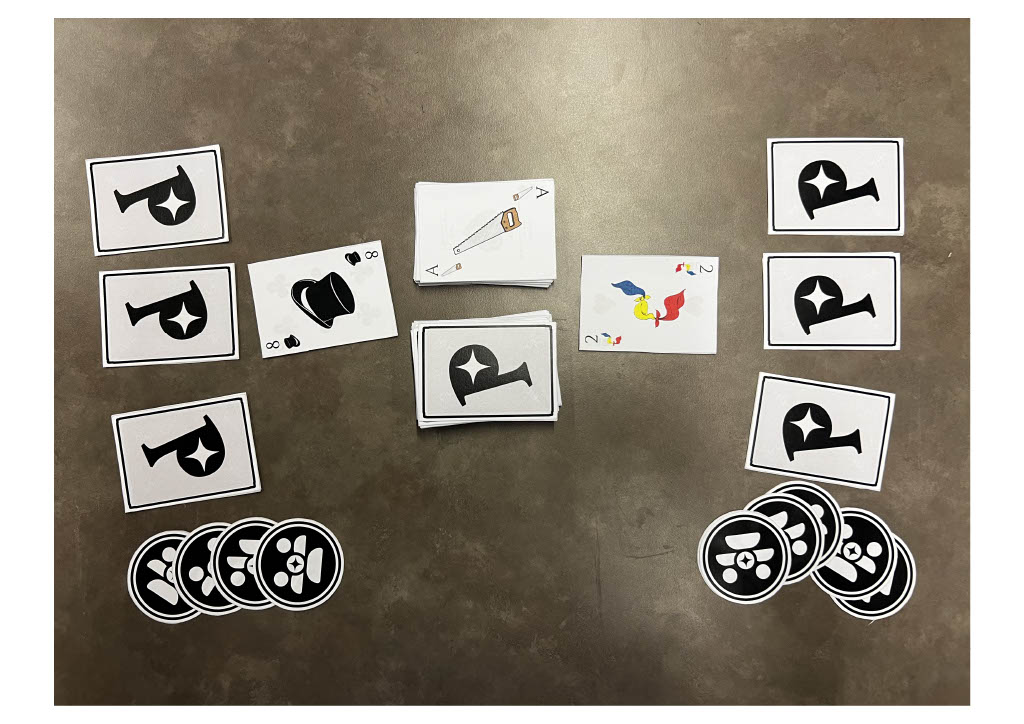
Although the design process of the game went rather smoothly, working in teams always presents it's own problems with creative differences. Mainly, me and my partner had differing visions for what we wanted the game to become and it was hard for both of us to come to turns with either dropping something from the game because the other didn't like it or because it didn't make sense for the game at the time.
One key issue we ran into at the end of Iteration #2 and #3 was with how I wanted to go about the deception system. Initially, at the start of system, we had it so both players would be able to choose from the same moves. During iteration #2, as a group we decided to assign me to work on this system while my group member worked on getting the card designs to what we wanted.
While working on the deception mechanic, I ran into issues with making series of moves that would make sense for all players to use at the same time. Through testing, I found that if one player used a deception move (action) intended to deceive the other player, the ideal response from that would be an ideal response (reaction) to that move. I found that both players could not be deceiving or doing an action to each other, this just didn't work for the game. A fix that I implemented for this late in Iteration #2 was making two sets of deception moves, one set being action moves and the other being reactionary moves to those actions.
After I solved that game problem, I ran into another problem with my teammate not being receptive to this change in the system. To add to it, although me trying to explain it to him, he was not receptive to it despite us not even doing a play test or asking players how they felt about it.
As the designer it was very hard juggling this implementation I liked and my teammates dislike of the implementation. Even after running a play test where the players were receptive to the change, my teammate was still upset about it. Because of this, I worked on a compromise.
The original implementation of the system was one where one player would have the sabotage moves and the other would be the respondent for the game. The change I intended to implement at the end of iteration #3 was making it so the game was capped at 15 rounds, split in between 3 acts with each player having opportunities to sabotage the other in one game.
Play testing was a very important part of the process of this game. Through play testing we were able to determine where to go forward with the game and where to stop. During play testing is where we determined the simplistic Rock, Paper, Scissors wasn't enough for the game and it needed something else.
Most importantly in play testing, for me who it was made my main focus at the end was the deception system. Through play testing I was able to determine what parts of the system worked and what parts didn't work. By asking players feedback and feelings about certain things I was able to better understand what they liked and how they felt about certain things.
A lot of the wording in our early iterations were spotty at best and hard for others unfamiliar with what we wanted to do as a team to understand. So when players went through our rule book and didn't know what something meant or we're confused by it, we went back and refined it.
For me, with the deception system, I went through a few moves by play testing them and getting feedback from players on something either being obsolete or over powered and changed accordingly. One of the final moves I ended up keeping for the game players originally didn't use because they felt it was useless. But based on feedback from the players on why they felt it was useless I was able to edit this move to make it one of the most played in the final iteration.
Ideally where we would've gone next for the project would have been a better balancing of our deception system. One issue I had was it felt the play testers were not giving us good enough feedback on these moves and how they went with one another or ideas and directions we could take it by adding or removing certain rules. Although I like the base of the system, I feel it could have massive improvements.
The other area I would like to take the project would be to work on the win condition, as it stands, there is nothing wrong with the win condition with it being capped on rounds and the implementation of audience points. But I do feel like it leaves a lot to be desired and it could be used to increase tension. I liked the idea me and my teammate compromised on with it being 15 rounds split into 3 acts and would elaborate and build on that in the future.
Another area was the deck, despite us making custom cards, they are just there to change the suit of traditional playing cards (2-10, J, Q, K, A) and I feel like there is room to change the number of cards in the deck or add special cards or trump cards.